Skip to main content Explore View all products (200+) Microsoft Foundry Azure Copilot GitHub Copilot Azure Kubernetes Service (AKS) Azure Cosmos DB Azure Database for PostgreSQL Azure Arc Microsoft Fabric Linux virtual machines in Azure Foundry Models Foundry Agent Service Foundry IQ Foundry Tools Foundry Control Plane Observability in Foundry Control Plane Azure OpenAI in Foundry Models Azure Speech in Foundry Tools Azure Machine Learning View all databases Azure Cosmos DB Azure DocumentDB Azure SQL Azure Database for PostgreSQL Azure Managed Redis Microsoft Fabric Azure Databricks Linux virtual machines in Azure Windows Server on Azure Azure Functions Azure Virtual Machine Scale Sets Azure API Management Azure Container Apps Azure Kubernetes Service (AKS) Azure Kubernetes Fleet Manager Azure Container Registry Azure Red Hat OpenShift Azure Container Instances Azure Container Storage Azure Arc Azure Local Microsoft Defender for Cloud Azure Monitor Microsoft Sentinel Azure Migrate View all solutions (40+) Cloud solutions for small and medium businesses Cloud migration and modernization center Data analytics for AI Azure Databases AI apps and agents Microsoft Marketplace Microsoft Sovereign Cloud AI apps and agents Responsible AI with Azure AI Infrastructure Data analytics for AI Machine learning operations (MLOps) Low-code application development on Azure Integration Services Serverless computing DevOps Migration and modernization center .NET apps migration Databases on Azure Linux on Azure Oracle on Azure SAP on the Microsoft Cloud Adaptive cloud High-performance computing (HPC) Infrastructure as a service (IaaS) Resiliency Azure Essentials Frontier Accelerate for Azure FinOps on Azure Microsoft Marketplace Azure pricing overview Create an Azure account Free Azure services Flexible purchase options Pricing calculator FinOps on Azure Maximize ROI from AI Azure savings plans Azure reservations Azure Hybrid Benefit Virtual Machines Azure SQL Microsoft Foundry Microsoft Fabric Azure Kubernetes Service (AKS) Microsoft Defender for Cloud View more Software Development Companies Microsoft Marketplace Find a partner Resources for Azure partners Get started with Azure Customer stories Analyst reports, white papers, and e-books Videos Learn more about cloud computing Documentation Explore Azure portal Developer resources Quickstart templates Resources for startups Developer community Students Azure for partners Blog Events and Webinars Learn Support Contact Sales Get started with Azure Sign in

Following the recent general availability of large disk sizes in Azure, we are excited to announce that Azure Site Recovery (ASR) now supports the disaster recovery and migration of on-premises virtual machines and physical servers with disk sizes of up to 4095 GB to Azure.

Many on-premises virtual machines that are part of the Database tier and file servers use disks with sizes greater than 1 TB. Support for protecting these virtual machines with large disk sizes has consistently featured as a top ask from both our customers and partners. With this enhancement, ASR now provides you the ability to recover or migrate these workloads to Azure.

These large disk sizes are available on both standard and premium storage. In standard storage, two new disk sizes, S40 (2TB) and S50 (4TB) are available for managed and unmanaged disks. For workloads that consistently require high IOPS and throughput, two new disk sizes, P40 (2TB) and P50 (4TB) are available in premium storage, again for both managed and unmanaged disks. Depending upon your application requirements, you can choose to replicate your virtual machines to standard or premium storage with ASR. More details on the configuration, region availability and pricing of large disks is available in this storage documentation.

To show you how Azure Site Recovery supports large disk sizes, I protected the Database tier VM of a SharePoint farm. You can see that this VM has data disks which are greater than 1 TB.
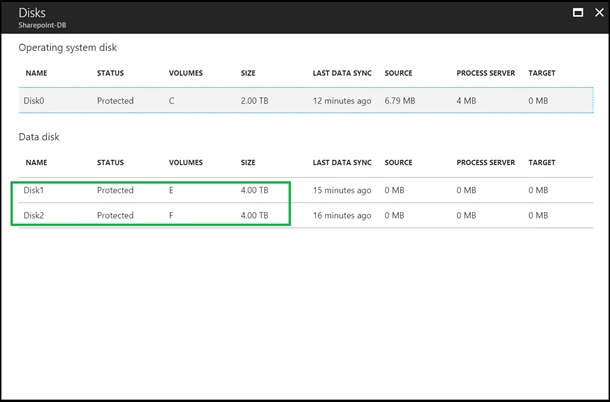
Large disks

Pre-requisite step for existing ASR users:

Before you start protecting virtual machines/physical servers with greater than 1 TB disks, you need to install the latest update on your existing on-premises ASR infrastructure. This is a mandatory step for existing ASR users.

For VMware environments/physical servers, install the latest update on the Configuration server, additional process servers, additional master target servers and agents.

For Hyper-V environments managed by System Center VMM, install the latest Microsoft Azure Site Recovery Provider update on the on-premises VMM server.

For Hyper-V environments not managed by System Center VMM, install the latest Microsoft Azure Site Recovery Provider on each node of the Hyper-V servers that are registered with Azure Site Recovery.

I would like to call out that support for Disaster Recovery of IaaS machines in Azure with large disk sizes is not available currently. This support would be made available soon.

Start using Azure Site Recovery today. Visit the Azure Site Recovery forum on MSDN for additional information and to engage with other customers. You can also use the ASR User Voice to let us know what features you want us to enable next.


WE ARE MICROSOFT

Explore Microsoft Foundry

The future of AI starts here. Envision your next great AI app with the latest technologies. Get started with Azure.