Customers rely on the Azure IoT Hub service and love the scale, performance, security, and reliability it provides for connecting billions of IoT devices sending trillions of messages. Azure IoT Hub is already powering production IoT solutions across all major market segments including retail, healthcare, automotive, manufacturing, energy, agriculture, oil and gas, life sciences, smart buildings, and many others. Today, we have a few exciting announcements to make about Azure IoT Hub.
Over the years we’ve noticed that many customers start their IoT journey by simply sending data from devices to the cloud. We refer to this as “device to cloud telemetry,” and it provides a significant benefit. We’ve also noticed that later in their IoT journey most customers realize they need the ability to send commands out to devices, i.e., “cloud to device messaging,” as well as full device management capabilities, so they can manage the software, firmware, and configuration of their devices.
At Microsoft, we believe in meeting customers where they are and providing a great experience for them to capture the benefits of IoT. Because of this, we’re excited to announce a new capability of Azure IoT Hub: a “device to cloud telemetry” tier, called the IoT Hub basic tier. The basic tier is a very inexpensive way to start your IoT journey, and despite the name, there is nothing basic about it. It supports inbound telemetry scenarios and has all the same security, scale, performance, and reliability of the existing Azure IoT Hub standard tier. And the best part is, when you’re ready to continue your IoT journey, you can upgrade from basic to standard with zero downtime and no re-architecture.
Next, we’ve also been busy building efficiencies into our Azure IoT Hub while dramatically increasing the reliability, scale, and performance of the service—far surpassing the scale and performance needs of our most demanding commercial IoT customers. We’re excited to announce today that we are passing those efficiencies on to our customers by saving them money with a 50 percent reduction in cost of our standard tier. Existing customers will automatically receive this pricing discount with no action needed on their part.
As of April 3, 2018, the following table* summarizes the new Azure IoT Hub basic tier offering and standard tier price reduction:
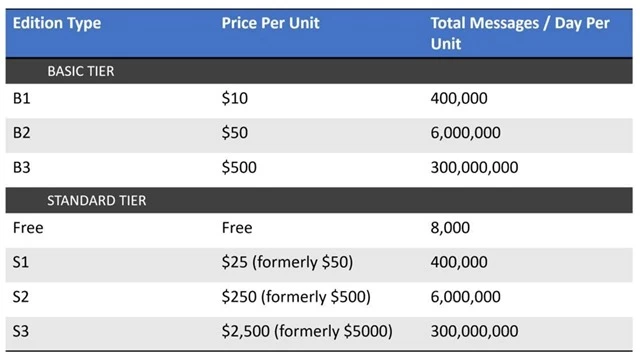
Note: All prices are in USD.
Azure IoT Hub basic tier: Details
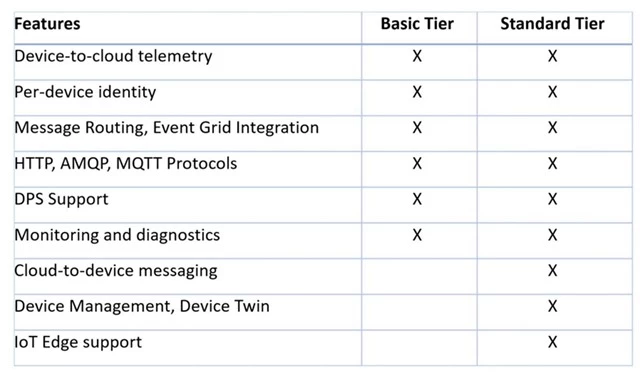
The new basic tier provides all the data ingestion features of Azure IoT Hub standard, such as zero-touch provisioning, as well as the same security features, performance, and scalability. Along with this powerful set of capabilities, you can also choose to upgrade to the IoT Hub standard tier at any moment as your IoT solution needs change. This will seamlessly unlock access for your solution to all the standard-tier features, including bi-directional communications, device management through device twins, and the delivery of cloud intelligence to your devices through Azure IoT Edge. All at a 50 percent savings from the previous standard tier pricing.
The following table summarizes the supported features for the basic and standard tiers:
The full pricing details and ordering information can be found on the IoT Hub pricing page. See Choosing the right IoT Hub for more details on the features and functionality available to each tier and how to select the right one for your IoT scenario.
The new tier of IoT Hub and new pricing are available now in global regions and will be available in national regions soon.
A comprehensive portfolio
Azure IoT Hub basic and IoT Hub standard are part of Azure IoT, a comprehensive IoT portfolio that enables companies to create, customize, and control all aspects of a secure IoT solution. The portfolio includes:
- Solutions: Get started quickly and choose the approach that meets your unique needs with either a fully managed global IoT SaaS (software-as-a-service) solution that enables powerful IoT scenarios without requiring cloud-solution expertise, or preconfigured solutions that enable common IoT scenarios to create a fully customizable solution.
- Platform services: Build a customized solution with platform services, such as Azure IoT Hub, to connect, manage, and capture data from billions of IoT devices. Then integrate your IoT device data with other business systems to enhance insights across your organization.
- Edge: Seamlessly deploy and run serverless computing, artificial intelligence (AI), and machine learnng directly on cross-platform IoT devices with Azure IoT Edge.
Learn more and get started with your IoT deployment today by visiting Azure IoT Hub.
*For the most up-to-date pricing information on the Azure IoT Hub basic tier offerings, please go to the Azure IoT Hub pricing page.