The Avere vFXT for Azure delivers new possibilities for running high-performance computing (HPC) workloads in the cloud. With this new software solution, you can now easily connect on-premises infrastructure to Azure compute or “lift and shift” file-based workloads in Azure to run between Azure blob in the same manner.
Organizations have long struggled with how they can leverage the cloud for high-performance, file-based workloads. Moving petabytes of data to the cloud is not a quick or simple operation, and organizational buy-in for wholesale moves of these workloads can be challenging. As a result, the majority of these often mission-critical applications have remained in local data centers even as demands for more and faster compute power continue — a problem easily solved with access to limitless cloud compute resources.
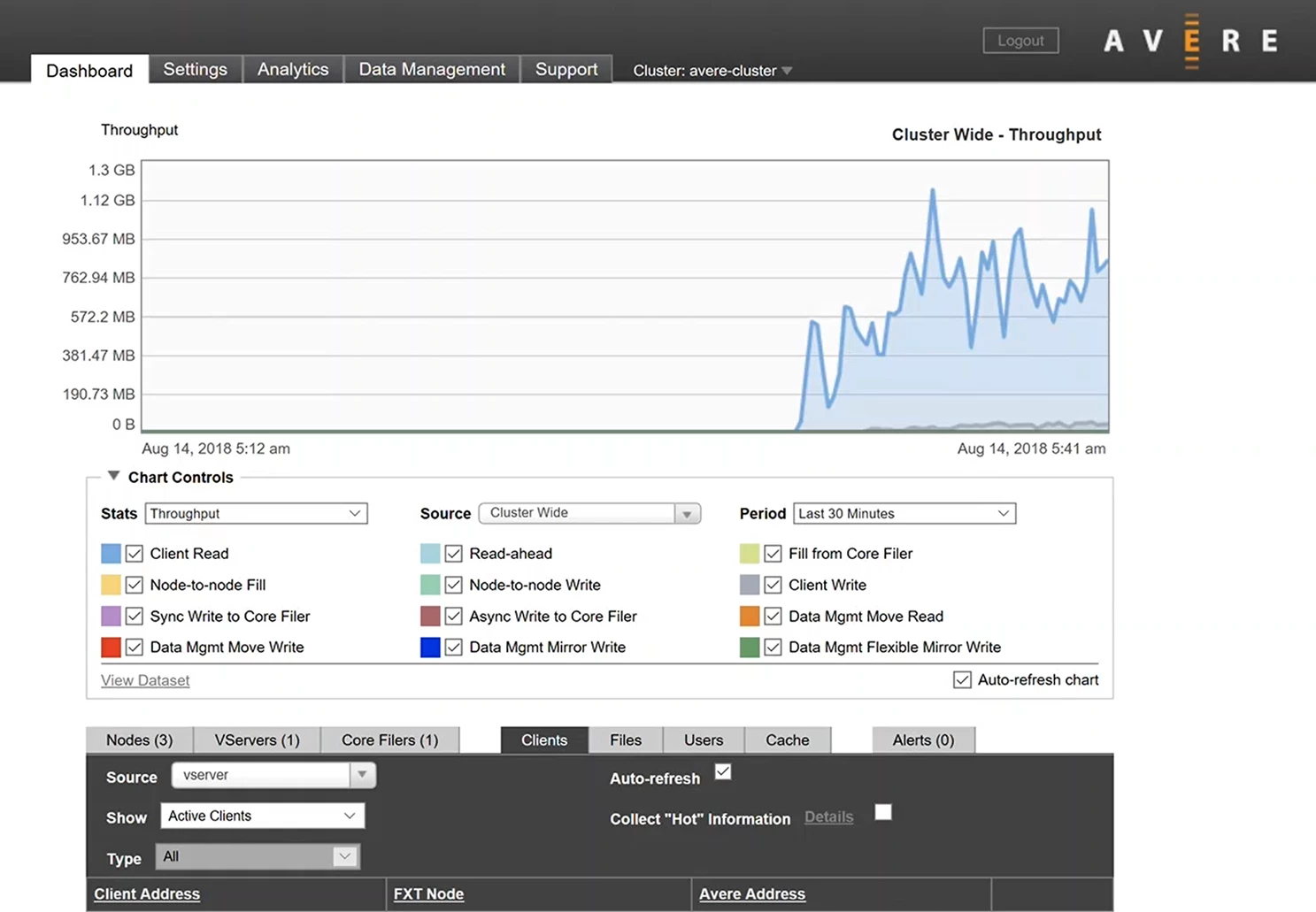
The new Avere vFXT for Azure solves the problem of running these enterprise HPC applications in the cloud while leveraging data stored on-premises or in Azure Blob. The Avere vFXT facilitates Edge computing as a virtual high-performance file caching appliance that runs in Azure Compute. With Avere, these critical workloads can access thousands of cores on-demand, increasing business agility by processing smarter and faster without adding extra cost.
For organizations that are planning on a hybrid infrastructure situation with on-premises storage and cloud computing, HPC applications can “burst” into Azure using data stored in NAS devices and spin up as many virtual CPUs on an as needed basis. The data set itself never completely moves into the cloud. The requested bytes are temporarily cached using an Avere cluster while processing.
For lift and shift deployments, organizations can take advantage of minimizing operational and capital costs by using Azure Blob as primary storage. The Avere vFXT tiers data stored in Azure Blob to an SSD-based cache in Azure Compute while the job is running. Once processing is complete, the data is written back into Blob. With this flexibility to support hybrid deployments and edge computing, the Avere vFXT becomes an important part of a cloud migration strategy for file-based applications in HPC environments.
Many industries can take advantage of the Avere vFXT for read-heavy, cacheable workloads. From media rendering in post-production studios to genomics processing in pharma or research, Avere hides latency between compute and storage to optimize productivity while providing access to Azure’s unlimited capacity. In manufacturing, energy, and government, companies leverage Avere to support ingest of large amounts of data for timely analytics and research. In hedge funds and investment banking, systems engineers make it easy for analysts to decide on strategies with efficient backtesting and quant analytics in the cloud. After years of working with competing cloud providers, we are extremely excited to bring the Avere vFXT to the Microsoft Azure portfolio.
We’re starting now with the public preview of Avere vFXT for Azure and we’ve set our sights on general availability this fall. With the below tips, you’ll easily match Avere to the right use cases.
- High-performance file caching: Avere vFXTs will support several common brands of network-attached storage (NAS) as well as Azure Blob API.
- Large core counts: Compute farms with about 1,000 – 40,000 cores work well with Avere vFXTs. These farms usually are facing fluctuation in demand as well as growth.
- Read-heavy workloads: Workloads running with Avere vFXT clusters are heavy read, infrequent write in nature (at least 70:30), and demand high performance relying on a clustered network-attached storage.
- Hybrid or all-in Azure support: Organizations in any stage of a cloud strategy can take advantage of Azure for HPC by using the Avere vFXT.
- Multi-cloud support: Many customers request solutions that will support multiple cloud providers. The Avere vFXT is also available for both Amazon Web Services and Google Cloud Platform. However, when use in Azure, the cost for Avere vFXT nodes is zero!
Just the beginning
Since Avere Systems joined Microsoft earlier this year, we are well on our way to delivering the Avere vFXT for Azure as a generally available Azure Marketplace product this year. And this is just the beginning! Customers will continue to see exciting enhancements and developments that provide even better support of high-performance hybrid cloud environments. The Avere vFXT is just one more way Microsoft is deepening the commitment to making Azure the cloud of choice for HPC.
Getting started
To join the preview, visit the Avere vFXT for Azure public preview page, or simply find Avere in the Azure Marketplace. Then get started by reviewing the installation documentation and launching an Avere vFXT cluster.
Pricing
The Avere vFXT for Azure has no charge associated with licensing. However, costs associated with consumption do apply at normal rates.
Share your experiences!
We would love to hear about your public preview experiences! Email us at averevfxt@microsoft.com with suggestions, comments, and stories. You can also share your thoughts in the Azure Storage Advisors forum.