Last year we announced the availability of the Azure Virtual Machine Da v4 and Das v4 series for general purpose Linux and Windows applications, and the Azure Virtual Machine Ea v4 and Eas v4 series for memory-intensive Linux and Windows workloads. All four virtual machine series are based on the AMD EPYC™ 7452 processor.
Today, we’re announcing the expanded availability of these virtual machine (VM) sizes in new Azure regions and support for additional Availability Zones. This wider deployment offers your organization the ability to span and run your applications around the world. The zonal region availability will allow you to build solutions with higher availability and improve the uptime of your applications.
Better price-performance
These virtual machines feature the AMD 2.35Ghz EPYC™ 7452 2nd Generation processor in a multi-threaded configuration with up to 256 MB L3 cache in which 8 cores have 8 MB of dedicated L3 cache to offer customers more optimization options for running their general purpose and memory-intensive workloads.
Azure Da v4 VMs offer up to 96 vCPUs, 384 GBs of RAM, and 2,400 GiBs of SSD-based storage for most enterprise-grade applications. The Dav4-series sizes offer a balanced configuration of vCPU, memory, and temporary storage providing a better value proposition for most general-purpose workloads. Example workloads are testing and development, small to medium databases, applications, and application servers.
Azure Ea v4 VMs – with up 96 vCPUs, 672 GBs of RAM, and 2,400 GiBs of SSD-based storage – are well suited for larger in-memory business-critical workloads, memory-intensive enterprise applications, and relational database servers, in-memory analytics solutions, and other workloads that benefit from having access to medium to large size of caches.
In February, an independent study by GigaOm compared SQL Server on Azure virtual machines to other cloud providers using a field test derived from the industry-standard TPC-E benchmark. The following report provides additional details: February 2020 GigaOm performance benchmark blog post. If you want to learn more about how to best run SQL on Azure IaaS, register for the upcoming webinar.
The Coremark benchmark is used to measure the performance of central processing units (CPU) in embedded systems. This Coremark benchmark page provides scores that show compute performance for Azure’s VMs running Ubuntu. Both Azure Da v4 and Ea v4 sizes show high performance amongst all the VM sizes.
More regions, more clouds
The Azure Da v4 and Azure Ea v4-series are now generally available in additional regions reaching a total of 18 regions worldwide.
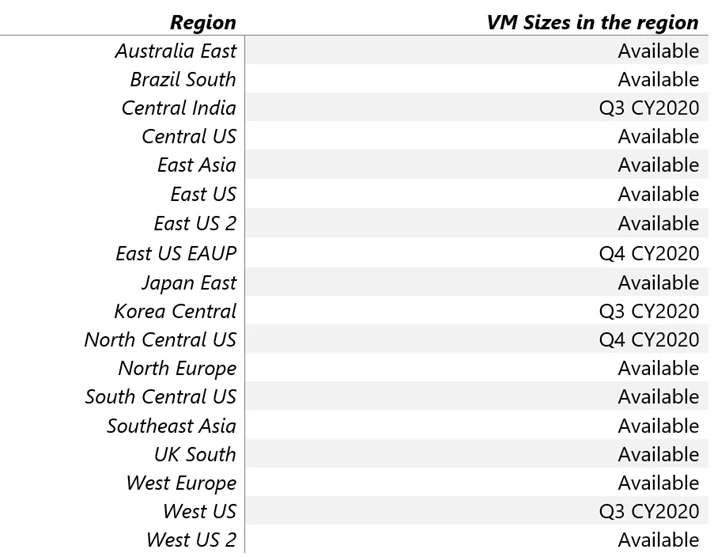
The roadmap for existing Availability Zone regions support for these VM sizes can be found below:
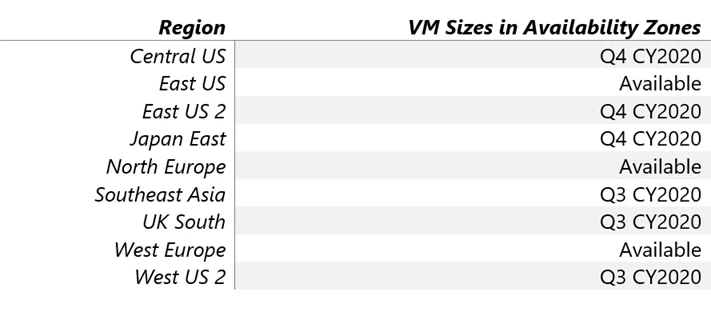
We continue to grow the number of regions with Availability Zones and the list and timeline for these regions can be found at Azure geographies.
The Dav4 and Eav4 Azure VMs can also run on Azure Dedicated Hosts, which provide physical servers that host one or more Azure virtual machines. Your server is dedicated to your organization and workloads—capacity is not shared with other customers. As you provision the host, you gain visibility into (and control over) the server infrastructure, and you determine the host’s maintenance policies.
To optimize your cloud spend, you can purchase Azure Reserved VM Instances for the Dav4 and Eav4 VMs. You can run these new sizes as part of VM Scale sets to build scale-out applications.
Last but not least, you can take advantage of Spot VM pricing to run your interruptible workloads on these VM series. With Spot VMs you acquire scalable compute capacity at deep discounts (up to 90 percent discount compared to pay-as-you-go prices.)
Achieve more with better performance
We have been working in collaboration with AMD while meeting our customer needs.
“We’re excited to see the global expansion of the AMD EPYC™ based Azure Da v4 and Ea v4 VMs which continue to showcase how the high-performance capabilities of the AMD EPYC™ processors can support end customer applications and workloads in the cloud” – Kumaran Siva, CVP, Data Center Cloud, AMD
With these new VM sizes and their expansion of the availability, our customers will be able to scale up and achieve more with better CPU performance.
“With Office online workloads, which rely on high compute performance for real time collaboration, by using AMD EPYC-based Azure VMs, we were able to see up to a 15 percent performance increase when compared to previous VM generations.” – Jim Kleewein, Technical Fellow, M365
“By utilizing the new Dasv4 VM-series that is based on the latest AMD EPYC processor, we hope to double our server density per VM.” – Kevin Gammill, GM, Gaming Developer Experiences
Get started today
• Learn more about Da v4-series.
• Learn more about Ea v4-series.