Cloud and edge computing are coming together as never before, leading to huge opportunities for developers and organizations around the world. Digital twins, mixed reality, and autonomous systems are at the core of a massive wave of innovation from which our customers already benefit.
From the outside, it’s not always apparent how this technology converges or the benefits that can be harnessed by bringing these capabilities together. This is why at Microsoft Build we talk about the possibilities this convergence creates, how customers are already benefitting, and our journey to making this technology easier to use and within reach of every developer and organization.
The possibilities of connected environments
Imagine taking any complex environment and applying the power of technology to create awe-inspiring experiences and reach new business heights that were previously unimaginable. The possibilities are endless: A retail store where the shopping experience is optimized in real-time and shelves are always stocked. A supply chain that tracks and reduces carbon emissions. A process manufacturing line that adjusts for variations in natural ingredients and automatically detects and compensates for operational bottlenecks. A city plan that simulates various growth proposals to ensure they’re making the best use of energy sources.
This is happening today. Customers like Anheuser-Busch (AB) InBev, Paris Saclay, ICA, Total, and Brookfield Properties are already implementing solutions that bring these scenarios to life. The key takeaway here is that by creating live, data-bound digital replicas of physical environments, we can apply modern software techniques—analytics, simulation, autonomous control, and interactions—in mixed reality to achieve previously impossible benefits.
This shift represents a convergence of the physical and digital worlds. As these spaces come together, they create a new world of opportunity and transformative solutions that will change everything. We think of these solutions as metaverse apps.
Forming the foundation with digital twins
Metaverse apps are the culmination of the intelligent cloud and intelligent edge working in harmony together—at their foundation is digital twins. Digital twins enable you to create rich digital models of anything physical or logical, from simple assets or products to complex environments. These environments can be energy distribution grids, warehouses, or factories—anything that’s important to you. Once it’s modeled, it can be brought to life and synchronized with the physical world using two-way IoT connections. This initial binding of the physical and digital is foundational to enabling metaverse apps.
Once this foundation is in place, you are able to start applying software techniques to your model; from there the world essentially becomes your digital canvas. You can run analytics to gain insights from the history of changes to your environment. You can predict future states of the environment—foreseeing when equipment will need servicing, or anticipating occupancy needs before they happen.
The next set of benefits come from simulations, which take copies of the digital twin and then run simulations on them. These simulations can evaluate “what-if” questions or seek insights and optimizations from massively complex environments using the power of the cloud—something impossible to achieve by simply monitoring the physical environment alone. Once these simulations are complete, you can apply insights from the simulated copy to the real digital twin and synchronize those changes back to the physical environment to realize the benefits. You can even create and apply autonomous systems to the digital twin to automate routine tasks and enhance them with systems that learn and improve over time.
Finally, one of the most powerful things you can do is interact with the digital model overlaid onto the physical environment in mixed reality. You can get rich metadata and insights into anything you’re doing in the physical world from this digital copy. You can also interact in pure virtual space, even over distances with colleagues and experts anywhere in the world.
The Microsoft Cloud brings this all together
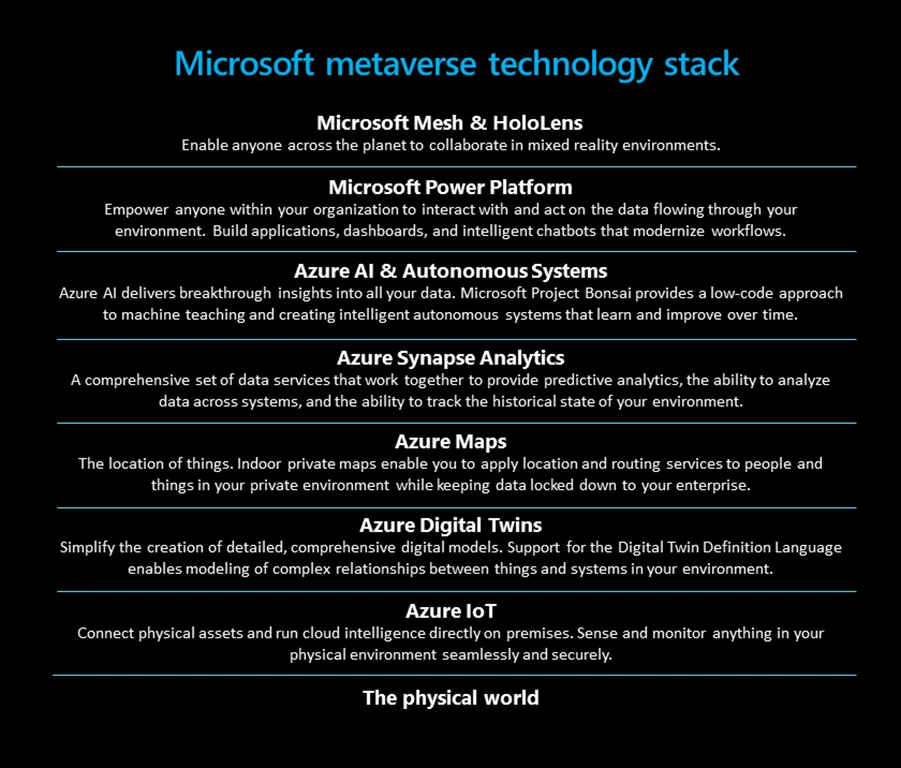
If you look at the different capabilities required for this new class of application, the Microsoft Cloud includes services for each capability. In fact, we’re uniquely positioned as a company to bring this entire stack together, and our bold ambition is to make this stack more connected and more seamless over time so you can easily move up and down the layers that enable metaverse applications.
Azure Digital Twins can model any asset, system, or entire environment and keep the digital twins live and up-to-date with Azure IoT. Azure Synapse Analytics tracks the history of digital twins and finds insights to predict future states. Our AI and machine learning platform lets you build autonomous systems that continually learn and improve. Enable presence and shared experiences from anywhere—on any device—using Microsoft Mesh. Experience the best of mixed reality devices and Microsoft Mesh with Microsoft HoloLens 2, one of the most immersive and ergonomic mixed reality devices. And Microsoft Power Platform enables every employee to expand on and interact with digital twin data using low-code, no-code solutions. Each layer of this technology stack is incredibly powerful on its own but used together it powers one of the most transformative waves of computing we’ve ever seen.
Creating the brewery of the future with Anheuser-Busch InBev
This technology stack used for metaverse applications is available today, and it is already enabling breakthrough transformation across industries: process manufacturing, retail, supply chain, energy, and healthcare. AB InBev is a great example of this. With more than 200 breweries and over 150,000 employees across the globe, AB InBev is the largest brewer in the world. They’re dedicated to the highest standards of quality and consistency, they’re experts in process manufacturing and they’re taking advantage of this stack to dramatically transform their operations.
AB InBev used Azure Digital Twins to create a comprehensive digital model of their breweries and supply chain. Synchronized with their physical environments, the digital model is live, up to date—reflecting the complex relationships between the natural ingredients and brewing process—and enables AB InBev’s brewmasters to adjust based on active conditions. This also provides frontline operators with an integrated view of quality and traceability information, helping them to maintain uptimes on the machines required during the packaging process.
AB InBev also uses deep reinforcement learning to help packing line operators detect and automatically compensate for bottlenecks in complex operations. They even use mixed reality over their digital twin for remote assistance, which fosters effective knowledge sharing across geographies. The control and optimization this technology stack provides allows AB InBev to make sure the perfect sip is delivered to customers every time, while still meeting their bold business and sustainability goals.
Powering end-to-end solutions
This stack is the foundation for end-to-end solutions that range from first- to third-party solutions delivered through our global partner ecosystem. Some of the solutions Microsoft is developing include:
- Microsoft Dynamics 365 Connected Store: Uses real-time observational data to improve in-store operations.
- Microsoft Dynamics 365 Guides: Provides an overlay of step-by-step holographic instructions on top of physical reality to help frontline workers work better and be more accurate.
- Microsoft Dynamics 365 Remote Assist: Enables workers to connect with an expert from anywhere on the planet in mixed reality with a shared view of the physical environment. This allows for rich knowledge sharing and training across organizations that breaks down physical barriers.
- Connected Field Service: Automatically calls for a repair technician when a machine needs help and helps enterprises coordinate maintenance.
Start developing your metaverse apps today
Implementing this technology stack isn’t a monolithic or linear process. There is no fixed starting point for building metaverse applications, and each layer can be progressively adopted. As we lean into the transformation that metaverse enables, we have a bold ambition to make these experiences easier to build and use—so that any business, anywhere on the planet, can reach its full potential. We can’t wait to see what you build with us.
For a deeper dive into our metaverse vision, the technology stack that brings it to life, and how organizations across the globe are putting it into action, watch our Microsoft Build session, Building Digital Twins, Mixed Reality, and Metaverse Apps.