Throughout our Internet of Things (IoT) journey we’ve seen solutions evolve from device-centric models, to spatially-aware solutions that provide real-world context. Last year at Realcomm | IBcon, we announced Azure IoT’s vision for spatial intelligence, diving into scenarios that uniquely join IoT, artificial intelligence (AI), and productivity tools. In the year since, we’ve progressed this vision by introducing new services designed to help enterprise customers across industries optimize the management of their spaces. Across Azure, Dynamics, and Office, Microsoft continues to accelerate results from a growing and diverse set of partners creating smart building solutions on our industry-leading enterprise platform.
This year we’ve returned to Realcomm | IBcon, joined by over 30 partners who have delivered innovative solutions using our spatial intelligence and device security services to provide safety to construction sites, operate buildings more efficiently, utilize space more effectively, and boost occupant productivity and satisfaction. Here we’ll tell you more about a selection of these smart building partners who are accelerating digital transformation in their industries.
Construction
IoT is an invaluable part of the smart building lifecycle, even before the building comes to fruition. On construction sites, it’s imperative for companies to prioritize employee safety while ensuring the job is completed on time and with the utmost quality. Microsoft offers a variety of services that come together to help construction companies onboard devices that can inform them about their site, model their physical world, and visualize data in the right context.
PCL Construction has embraced and led digital transformation in the construction industry with its Job Site Insights application. Job Site Insights sources its data from a variety of IoT sensors in the field, models that data in the context of the physical world using Azure Digital Twins, and then visualizes and interacts with that data through tools and canvases such as Azure Maps, Microsoft Office 365, and PowerBI. By gathering and analyzing IoT data, PCL is improving its processes to increase quality, safety, efficiency, and productivity while positioning itself as a future-ready builder.
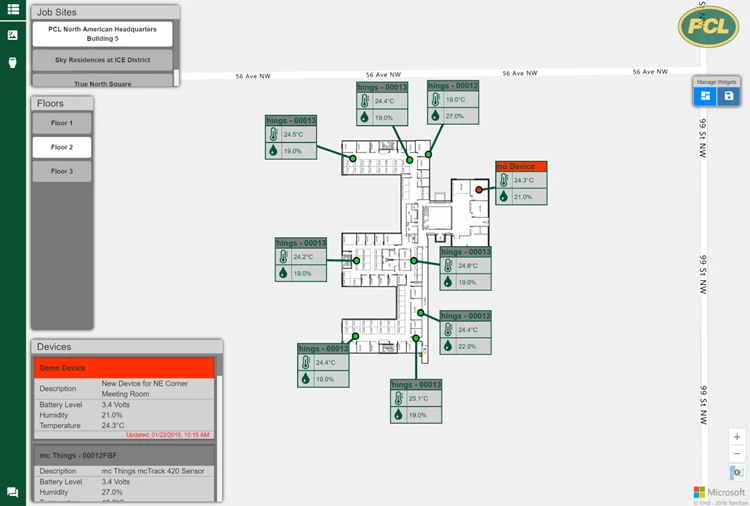
PCL’s Job Site Insights uses Azure Digital Twins to model the physical environment and Azure Maps to visualize geospatial data to ensure employee safety and keep the project on schedule.
Building operations
Building operators are reducing their costs and increasing their margins by enabling digital feedback loops which power predictive maintenance, process efficiency, and more. Harvard Business Review found that 72 percent of executives say their prime business goals for smart buildings are reducing facilities and operations costs and improving profitability. Microsoft’s services have enabled partners to integrate their solutions to solve the needs of building operators throughout the industry.
ICONICS provides automation software solutions that visualize, historize, analyze, and mobilize real-time information. It uses a variety of Azure IoT services to ingest data from building equipment and environmental sensors, which are presented to facilities operators and managers as dashboards and can be used to alert technicians through Dynamics 365 Field Service if problems such as clogged air filters or burst pipes need to be solved. ICONICS’ data is also used by other Microsoft partners including Willow, whose WillowTwinTM platform uses Azure Digital Twins to integrate, analyze, and manage data at scale, delivering insights to improve the performance and experience of buildings and infrastructure networks. These insights can be used for many essential scenarios, including using machine learning to run safety simulations to determine the best evacuation route, and even modifying digital signage in real time to guide people to an appropriate exit. WillowTwin is commonly leveraged to manage energy utilization, handover buildings from construction to building operator, analyze building performance across an entire portfolio, and manage fault detection and maintenance.
MacDonald-Miller, a facilities management company with mechanical engineers, electricians, plumbers, and HVAC technicians, uses Dynamics 365 Field Service to manage and dispatch field technicians while running the integrated ICONICS and Willow solutions in its own Azure subscription to provide services to its customers for daily operations. In the field, technicians from these companies can use RealWear HMT-1 hands-free industrial wearable headsets that attach to their hard hats and allow them to see all the telemetry, faults, and work orders in real time while working on a piece of equipment. Operators can also use voice commands to request more information, to start calls through Microsoft Teams, and to dictate notes as they work.
Infosys is a global leader in next-generation digital services and consulting of smart building solutions using Microsoft offerings. Its SCALE (Sustainable, Connected, Affordable, Learning (Systems), Experiential) framework helps assess, design, implement, and manage smart buildings leveraging data and insights from connected assets. These insights help with energy efficiency management, improved asset security/surveillance, enhanced end user experience, improved building operations, predictive maintenance, and significantly reduced operational costs.
Space utilization
Building owners, operators, and occupants alike have a vested interest in physical space management in smart offices. Many offices in the United States have open floor plans to spur collaboration, while hotdesking and co-working spaces are becoming increasingly common as workers are becoming more mobile. Microsoft’s partners are helping their stakeholders optimize space usage since unused space wastes rent and increases utility and maintenance costs.
Steelcase, a global firm specializing in architecture, furniture and technology products and services designed to help people reach their full potential, started its IoT journey by using Azure Digital Twins as the foundation for its Steelcase Workplace Advisor app, which collects space utilization data and transforms it into actionable insights for a more effective workplace. More recently, Steelcase complemented the same Azure IoT backbone with Microsoft Graph integration to create Steelcase Find, which gives occupants quick access to the best workspaces across their organization so they can spend less time searching and more time collaborating.
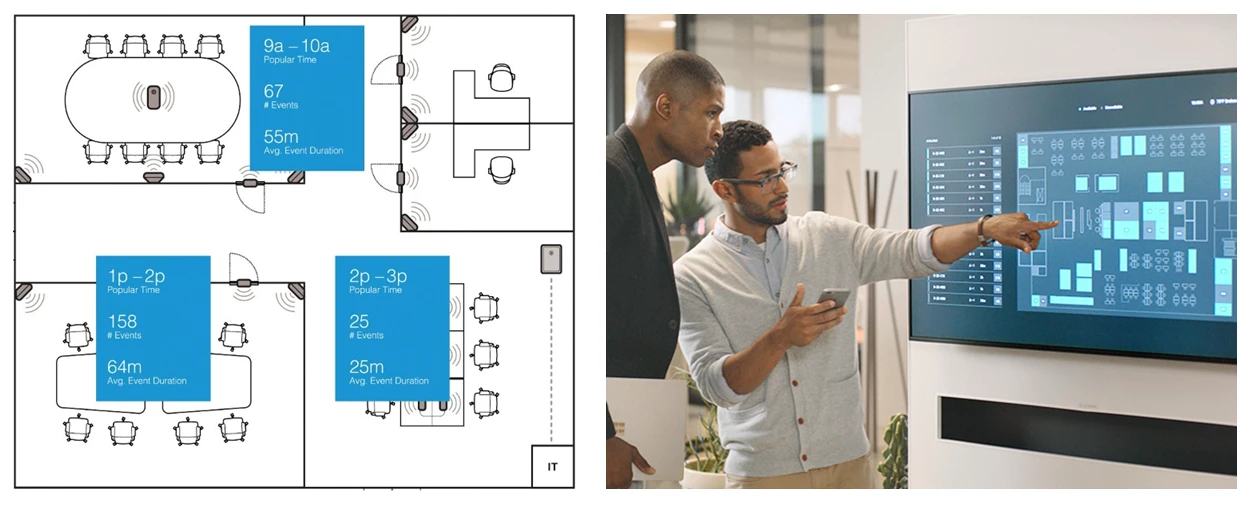
Steelcase has accelerated its IoT development with Azure Digital Twins and the Microsoft Graph, building its Steelcase Workplace Advisor app for facility managers (left) and Steelcase Find app for occupants (right).
Occupant experience
Building occupants desire engaging spaces, ones which can power personalized experiences while providing fewer distractions and higher productivity. Harvard Business Review found that a majority of building owners and operators are paying close attention to this segment because smart buildings are not only a driver for talent and recruiting, but also a catalyst for employee productivity. Microsoft’s partners are delivering innovative solutions on our platform to empower building occupants.
As a world leader in commercial real estate services, CBRE strives to provide building owners and occupiers with ever-greater experiences and services. One way it does so is through the introduction of CBRE Host, a workforce empowerment platform that offers capabilities including room scheduling, service requests, and wayfinding to add delight and efficiency to employees’ lives. Simultaneously, facility managers are empowered to deliver more timely maintenance, and building owners/investors gain insight into space and service utilization.
CBRE Host is powered by Microsoft Azure Digital Twins and the Microsoft Graph. While remaining agnostic on sensor connections, key shared partners Rigado and Yanzi Networks accelerate Host deployment through their turnkey packages for gateways, access points, occupancy+comfort sensors, and device management capabilities built on the Azure IoT platform. As Host evolves, key tests underway include integrating Azure Spatial Anchors, a mixed reality service that enables employees, guests, and building managers to use a smartphone, tablet, or HoloLens to find and activate virtual anchors in their environment to populate real-time data in the context of the physical world.
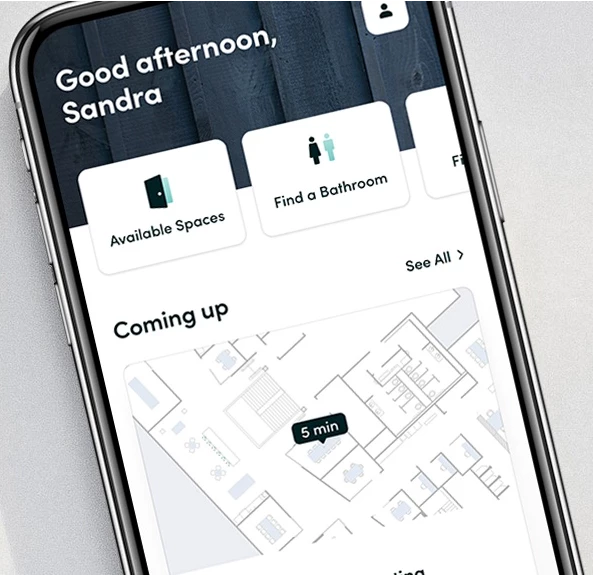
CBRE Host helps occupants be more productive by finding available rooms that fit their needs and helping route occupants within their buildings.
Sagegreenlife’s living walls bring the benefits and beauty of nature into man-made spaces. The company needed a way to remotely monitor its irrigation systems and ensure optimal plant wall performance but didn’t have the developer expertise in-house, so it turned to Microsoft and Cradlepoint for help. Today, Sagegreenlife uses Azure IoT Central and Cradlepoint LTE network solutions to detect and resolve issues before they affect plant health. With this IoT solution, Sagegreenlife can provide an exceptional customer experience, deliver new insights across the organization, and scale its business on a highly secure, easy-to-use, customizable platform.
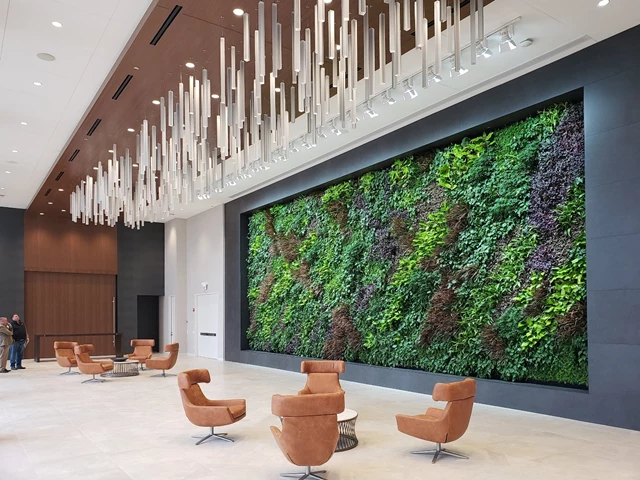
Sagegreenlife uses Azure IoT Central to monitor its irrigation systems and optimize plant wall performance.
Device security
Throughout the world’s commercial real estate properties, there are millions of microcontroller-based BACnet devices enabling scenarios that control building systems. While there are significant efforts being made to secure the BACnet messaging protocol, the devices themselves frequently lack sufficient security to ensure they are not vulnerable to being taken over or spoofed, which could lead to unexpected behavior on a building’s network. L&T Technology Services has partnered with the Azure Sphere team to build a guardian module implementation that can protect BACnet devices while translating the messaging protocol into MQTT messages that can be ingested by Azure IoT Hub and IoT Central. With the capabilities that L&T is delivering, device manufacturers and building management organizations can retro fit the “Seven Properties of Highly Secure Devices” into its solutions.
Next steps
We’re excited to see the accelerated innovation and momentum from partners over the last year as we’ve continued to provide tools to enable developers to create digital feedback loops for building owners, operators, and occupants. Microsoft will continue to empower our partners to deliver smart building solutions with powerful services and platforms to model and sense the physical world, derive insights from spatial data, and create innovative experiences for building owners, operators, and occupants. Together with our partners, we’ve also highlighted five key learnings for accelerating smart buildings solutions. Check out our 30 plus partners at Microsoft’s booth, Microsoft’s Partner Pavilion, and partner booths at Realcomm | IBcon 2019!
Additional resources
Partner list
Select the partner logo to visit their websites and to learn more about their specific solutions.
| Partner logos | |||
 |  |  | |
 |  |  |  |
 |  |  |  |
 |  |  |  |
 |  |  |  |
 |  |  |  |
 |  |  |  |
 |  |  | |
 |  |  | |