At Microsoft Quantum, our ambition is to help solve some of the world’s most complex challenges through the world’s most scalable quantum system.
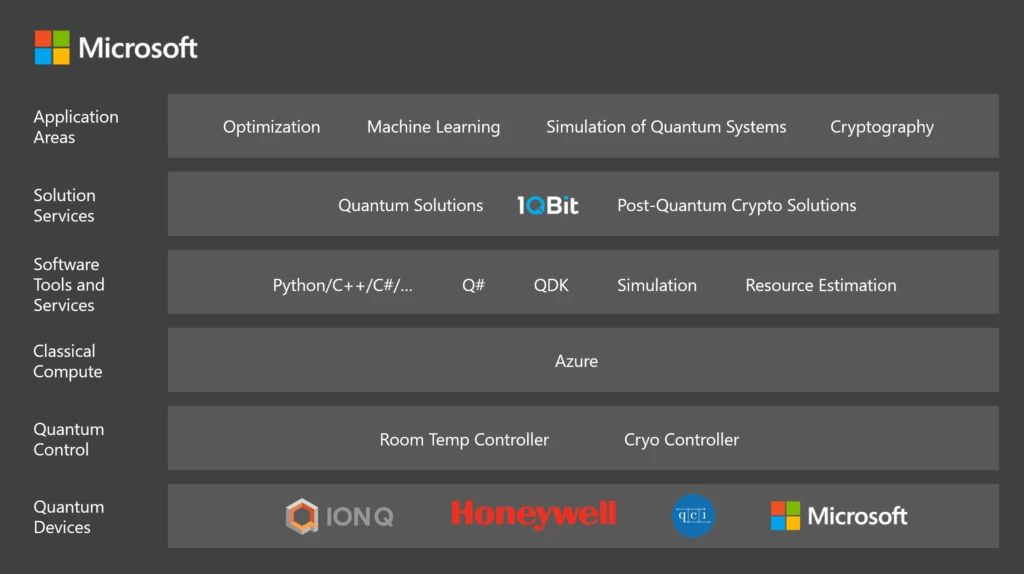
To deliver on that promise, we’ve been working together with a global quantum community to innovate across every layer of the quantum stack – from applications and software down to control and devices.
- Leading cryptographers at Microsoft Research are developing quantum-resistant public-key cryptographic algorithms and protocols to prepare customers and data centers around the world for a quantum future.
- Developers are already contributing to the growing quantum community through Q# and our open source Quantum Development Kit, which today has more than 200,000 downloads.
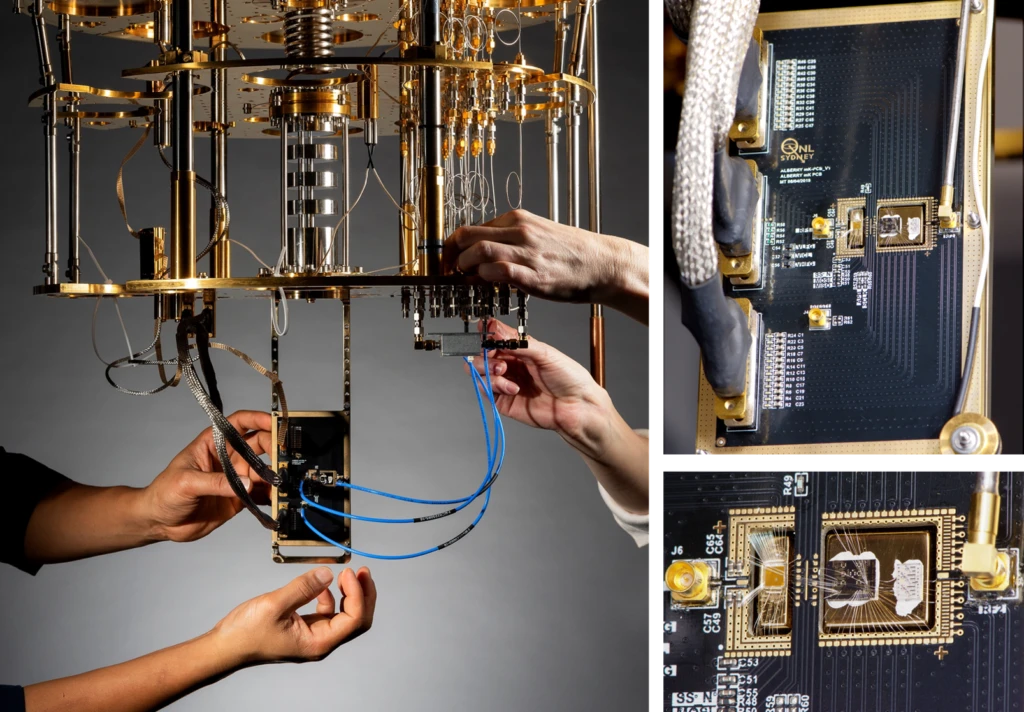
- Recently, Microsoft’s Quantum Lab located at the University of Sydney made breakthroughs in qubit control technology that allow us to scale beyond the physical limitations of current conventional systems. We now have the ability to control up to 50,000 qubits through simply three wires, a cryogenic CMOS design, and a 1cm2 chip computing at near absolute zero temperatures.
These are simply a few examples of advancements across the stack that are bringing the promise of quantum to our world, right now. Today, we’re introducing our next step in delivering quantum impact: Azure Quantum.
Learn, build, and solve with Azure Quantum
Azure Quantum is a full-stack, open cloud ecosystem that will bring the benefits of quantum computing to people and organizations around the world. Together with our partners 1QBit, Honeywell, IonQ, and QCI, we’re assembling the most diverse set of quantum solutions, software, and hardware across the industry, in Azure.
- Learn. Anyone can come to Azure Quantum to learn about quantum computing through a series of tools and learning tutorials, like the quantum katas.
- Build. Developers can write programs with Q# and the QDK and experiment running the code against simulators and a variety of quantum hardware.
- Solve. Customers can solve complex business challenges with our pre-built solutions and algorithms running in Azure.
With one program, you’ll be able to target a variety of hardware through Azure Quantum – Azure classical compute, quantum simulators and resource estimators, and quantum hardware from our partners, as well as our future quantum system being built on revolutionary topological qubit. As quantum systems evolve, your code endures.
Delivering quantum impact today
Customers across a wide range of industries are already seeing the impact of our quantum solutions built on the tools and services available in Azure.
In collaboration with Microsoft, Case Western Reserve University created an MRI scan that takes a third of the time of a conventional MRI based on quantum solutions running on classical hardware. These advances in speed could help doctors detect diseases earlier, develop new drugs for conditions where progress is hard to measure today, or use imaging to diagnose cancers rather than relying on invasive procedures like biopsies.
OTI Lumionics develops advanced materials for OLED displays for use in next generation consumer electronics. This includes fully transparent displays that can integrate under-display cameras. Using their quantum chemistry applications with Microsoft’s quantum-inspired algorithms running in Azure, the team was able to successfully simulate Alq3, an OLED fluorescent material, with greater accuracy than typical methods available today. These quantum solutions enabled the team to achieve simulation without the need for expensive high-performance computations or a scalable quantum system. This marks a milestone in chemistry simulation that could inspire more efficient and scalable methods of materials, chemical and drug discovery across the industry.
Join the global quantum community
We’re excited to continue collaborating with developers and organizations through Azure Quantum, which will launch in private preview in the coming months. We hope you’ll sign up to become an early adopter!
With Azure Quantum, our ambition is to empower every developer and every organization to experience quantum impact at every stage of this quantum revolution – today and tomorrow.
Request to be an early adopter on Azure Quantum and get started with our Quantum Development Kit today.
Interested in joining the Microsoft Quantum Network of partners, customers, and labs? Let us know by submitting a request.