We are excited to announce that Science, a leading academic journal, has published a new paper entitled Flux-Induced Topological Superconductivity in Full-Shell Nanowires. This research, born from a cross-disciplinary collaboration on the Microsoft Quantum team, highlights how theoretical physics, experimental physics, and materials science can unite across academia and industry to generate new ideas that lead to breakthrough technologies.
Our approach: topological systems
At Microsoft Quantum, our ambition is to help solve some of the world’s most complex problems by developing scalable quantum technology. Our global team of researchers, scientists, and engineers are addressing this challenging task by developing a topological qubit.
To realize this vision, our teams have been making advances in materials and device fabrication, designing the precise physical environment required to support the topological state of matter. The latest discovery by the team expands the landscape for creating and controlling the exotic particles critical for enabling topological superconductivity in nanoscale devices.
Discovery: a new route to topology
Our qubit architecture is based on nanowires, which under certain conditions (low-temperature, magnetic field, material choice) can enter a topological state. Topological quantum hardware is intrinsically robust against local sources of noise, making it particularly appealing as we scale up the number of qubits.
An intriguing feature of topological nanowires is that they support Majorana zero modes (MZMs) that are neither fermions nor bosons. Instead, they obey different, more exotic quantum exchange rules. If kept apart and braided around each other, similar to strands of hair, MZMs remember when they encircle each other. Such braiding operations act as quantum gates on a state, allowing for a new kind of computation that relies on the topology of the braiding pattern.
A topological qubit is constructed by arranging several nanowires hosting MZMs in a comb-like structure and coupling them in a specific way that lets them share multiple MZMs. The first step in building a topological qubit is to reliably establish the topological phase in these nanowires.
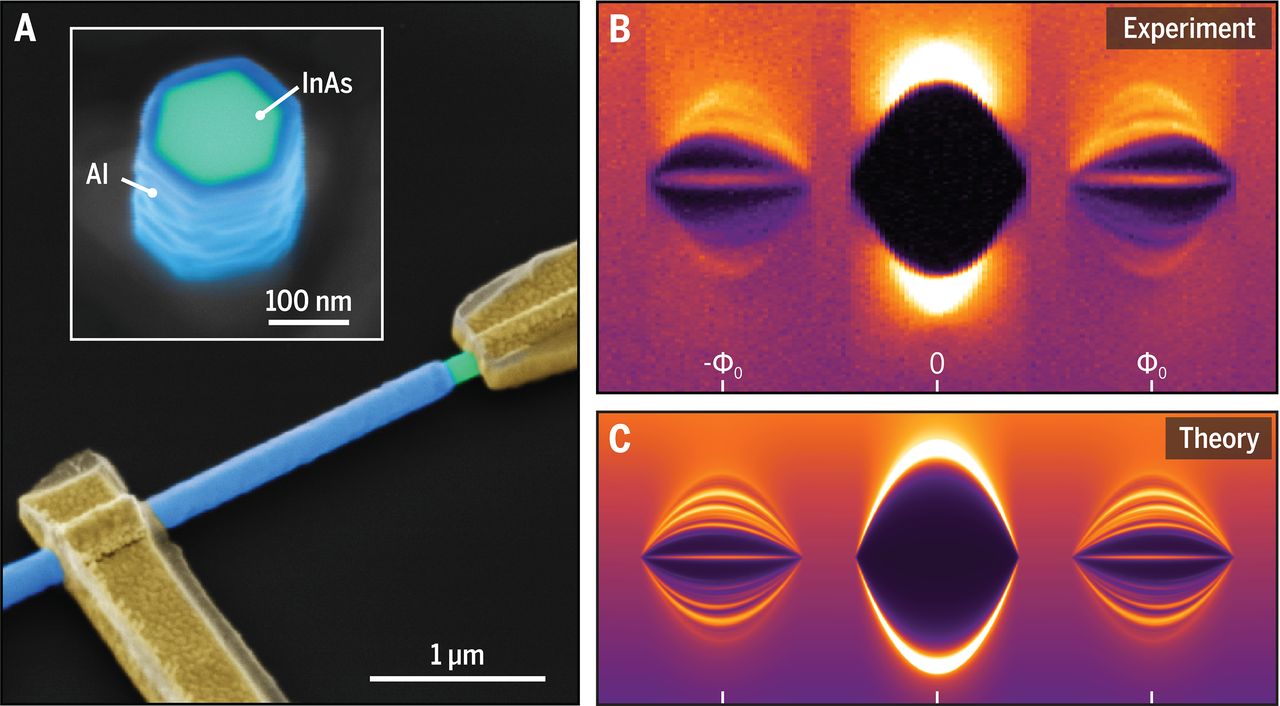
While exploring the conditions for the creation of topological superconductivity, the team discovered a topological quantum vortex state in the core of a semiconductor nanowire surrounded on all sides by a superconducting shell. They were very surprised to find Majorana modes in the structure, akin to a topological vortex residing inside of a nanoscale coaxial cable.
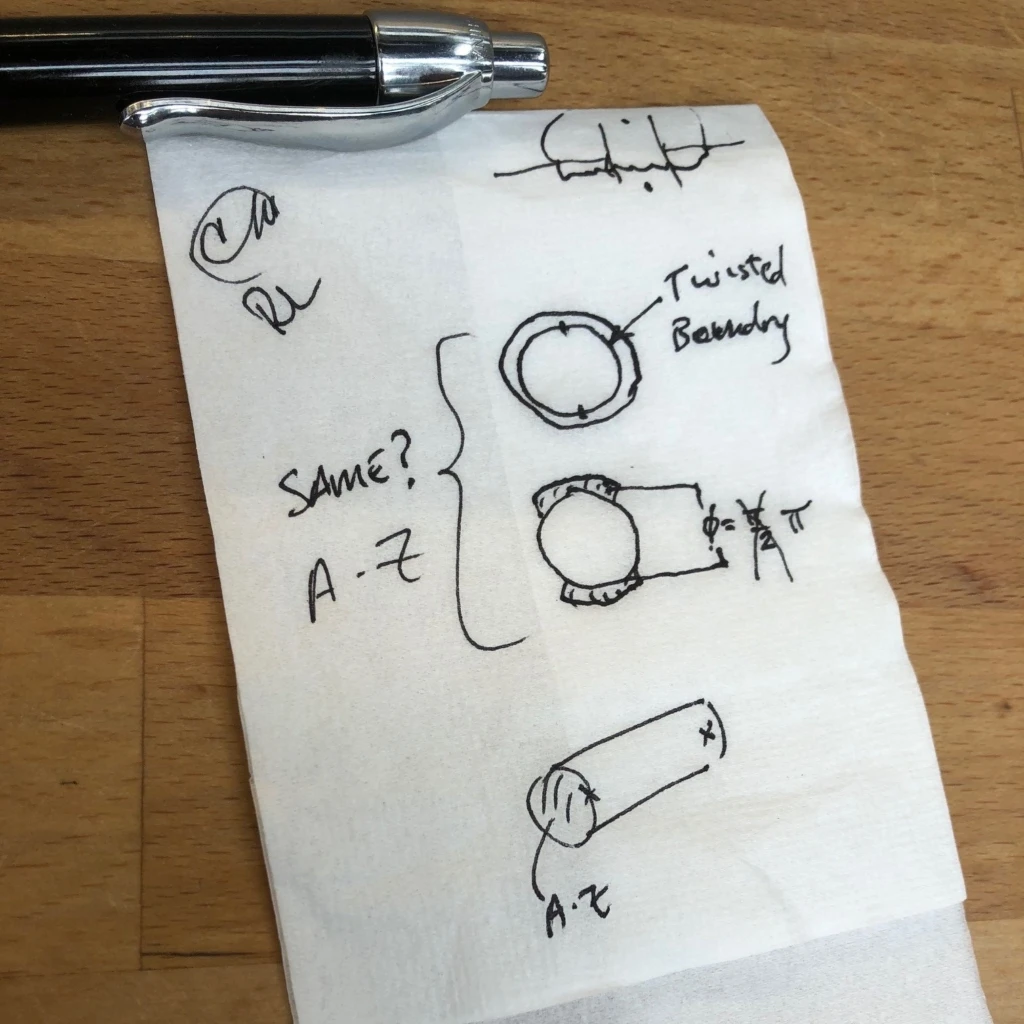
With hindsight, the findings can now be understood as a novel topological extension of a 50-year old piece of physics known as the Little-Parks effect. In the Little-Parks effect, a superconductor in the shape of a cylindrical shell – analogous to a soda straw – adjusts to an external magnetic field, threading the cylinder by jumping to a “vortex state” where the quantum wavefunction around the cylinder carries a twist. The quantum wavefunction must close on itself.
Thus, the wavefunction phase accumulated by going around the cylinder must take the values zero, one, two, and so on, in units of 2π. This has been known for decades. What had not been explored in depth was what those twists do to the semiconductor core inside the superconducting shell. The surprising discovery made by the Microsoft team—experiment and theory—was a twist in the shell, under appropriate conditions, can make a topological state in the core, with MZMs localized at the opposite ends.
While signatures of Majorana modes have been reported in related systems without the fully surrounding cylindrical shell, these previous realizations placed rather stringent requirements on materials and required large magnetic fields. This discovery places few requirements on materials and needs a smaller magnetic field, expanding the landscape for creating and controlling Majoranas.
Worldwide collaboration
What started as two separate papers – one experimental, the other theoretical – was combined into a single publication that tells the complete story, with mutual support of experiment, theory, and numerics.
Of course, looking back, deep connections to previous ideas and experiments can now be recognized, and results that were first mysterious now seem inevitable. That is the nature of scientific progress: from seemingly impossible to seemingly obvious after a few months of making, measuring, and thinking.
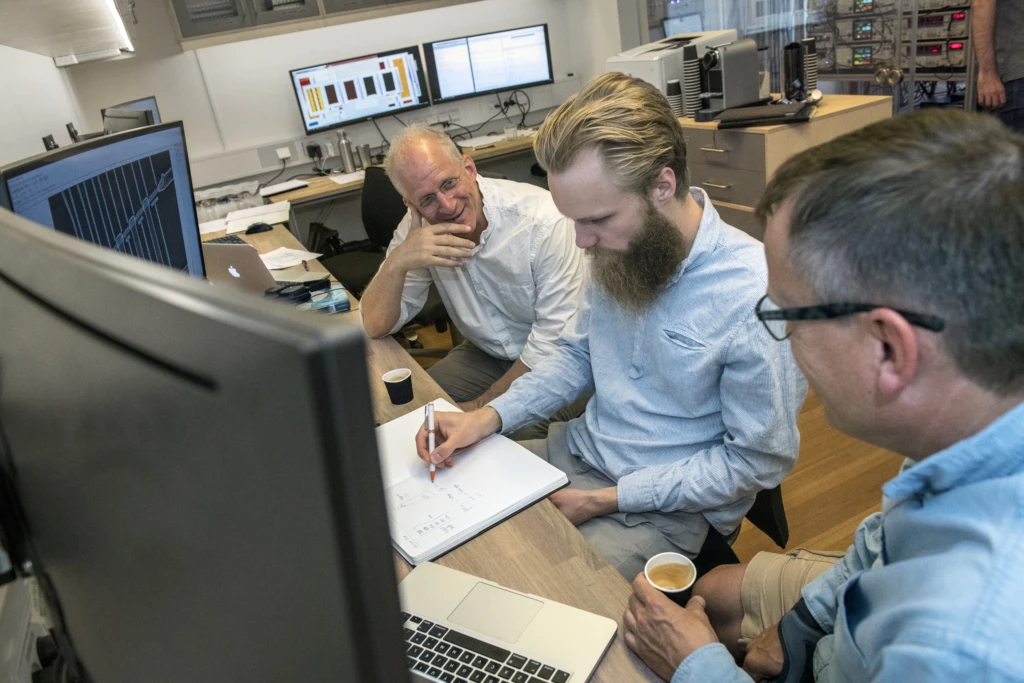
Saulius Vaitiekėnas, then a PhD student and postdoc at the Niels Bohr Institute, University of Copenhagen, and now a newly minted Microsoft researcher, was the main experimentalist. As he comments, “The paper represents a series of surprises. And it was really exciting to see so many different disciplines come together, all in a united activity.”
Roman Lutchyn, Principal Research Manager and lead of the theoretical effort, reflected on the collaboration process. “Microsoft Quantum started with just a small group in Santa Barbara. Now we’ve grown into a much broader organization with labs all around the world – Copenhagen, Delft, Purdue, Sydney, Redmond, among others. I think this paper is a landmark in our partnership between teams and is a model of how we can work effectively together as one team – around the world – on related ideas in physics, ultimately generating new and potentially important results.”
Charles Marcus, Scientific Director of Microsoft Quantum Lab – Copenhagen and lead for the experimental effort, concurs, “[This paper is an example] where two results – from theory and experiment – help each other to make more conclusive statements about physics. Otherwise, we would have been left with more abstract theory; and experimentally, we would have measurements but may have hedged on interpretation. By merging theory and experiment, the overall story is stronger and also more interesting, seeing the connection to related phenomena in different systems.”
We congratulate the team on their recognition in the scientific community and look forward to further discoveries in moving the world closer to quantum computing making a positive impact on the world.