Red Hat JBoss Enterprise Application Platform (EAP) on Azure App Service is a fully managed offering for Java EE (Jakarta EE) applications. Java developers have been deploying and scaling their Tomcat, Spring Boot, and other Java apps on App Service since 2014—when the platform first supported Java. Since then, our customers have told us they want the same hosting option for their Java EE (Jakarta EE) applications.
We heard your feedback and partnered with Red Hat to offer JBoss EAP on App Service, which has been in preview since September 2020. Our customers are excited to have a managed platform for their Java EE (Jakarta EE) applications and the peace of mind that comes with joint support from Red Hat and Microsoft. Today, the offer is generally available, so you can deploy apps into Red Hat JBoss EAP on App Service with no Red Hat subscription or licenses required.
Red Hat and Microsoft are both committed to extending choice and flexibility for organizations as they shift traditional Java applications to the cloud. Red Hat JBoss EAP on Azure offers customers a fully configured, jointly supported solution to make it easier for organizations to realize the benefits of cloud-based architecture. We look forward to continuing to build upon our long-standing relationship with Microsoft and expand support for our joint customers.”—Rich Sharples, Senior Director of Product Management – Application Services, Red Hat
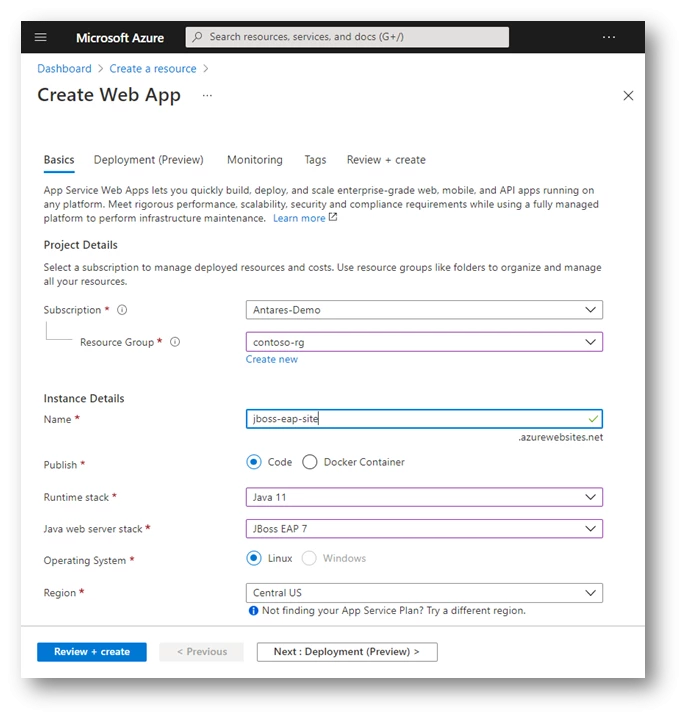
Figure 1. App service creation App Service interface showing the available options for creating a JBoss EAP application.
This means you can leverage all of App Service’s platform features for your Java EE (Jakarta EE) applications, such as:
- Automatic scaling based on metrics such as requests, CPU, memory utilization, or simply the time of day.
- Application insights auto-instrumentation for monitoring slow or failing requests, exception logging, and distributed tracing.
- Automatic updates for the Operating System, Java virtual machine, and Red Hat JBoss EAP server. You can also choose specific versions of JBoss and update them on your own terms.
- Deployment APIs and integrations with Maven, GitHub Actions, and popular IDEs.
- Networking integrations to secure and isolate your applications from the internet.
Purpose-built APIs to deploy and run your Java EE applications
Red Hat JBoss EAP on App Service is a jointly supported Pay-as-You-Go (PAYG) offer, which means you do not have to purchase a support subscription from Red Hat ahead of time. Simply create a JBoss EAP web app from the Azure portal or command-line interface (CLI) and start deploying your Java EE apps. If you run into an issue or have a question, create a support case with Microsoft or Red Hat, and support engineers from both companies will collaborate to resolve your case. A support fee for integrated support will automatically be applied to all JBoss EAP sites starting on August 1, 2021*. For more information, check out the App Service pricing page.
Whether your Java applications are packaged in an EAR, WAR, or JAR, App Service has purpose-built APIs to deploy and run your applications. These are integrated into the Azure CLI, Maven plugin, and other tools for a seamless developer experience.
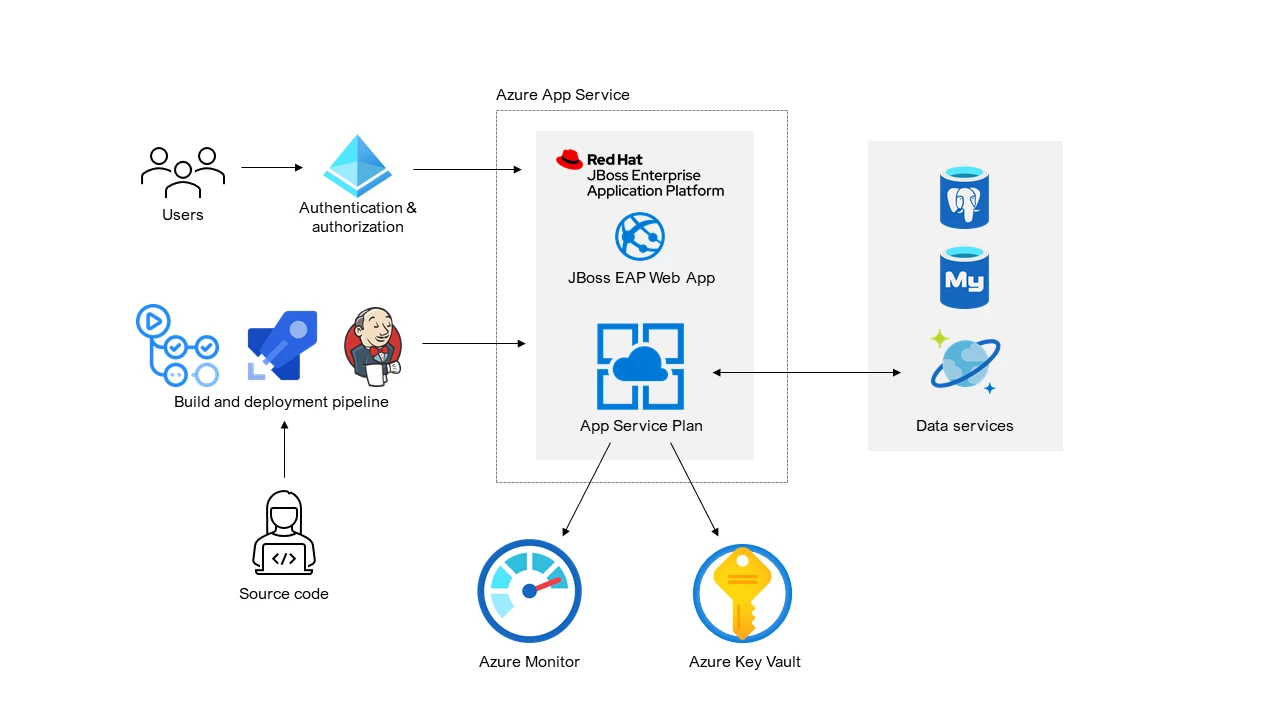
Figure 2. High-level architecture diagram showing Red Hat JBoss EAP on App Service connecting to other Azure services and users.
Red Hat JBoss EAP on App Service is offered on the Premium V3 and Isolated V2 App Service plan types. This means you can deploy Red Hat JBoss EAP onto the latest version of the App Service environment for added security and scale, or onto the multi-tenant variant of App Service. In either case, you can save on your hosting bill with Reserved Instance (RI) pricing, which allows you to make a one- or three-year commitment and save up to 35 percent and 55 percent, respectively.
Ready to get started?
Try the quickstart to learn how to use the Maven plugin to create a Red Hat JBoss EAP site and deploy a sample application. Next, head to Microsoft Learn to connect your JBoss EAP site to a MySQL database running on Azure. Finally, read the migration guide when you are ready to migrate your Java EE (Jakarta EE) applications to Red Hat JBoss EAP on App Service.
Resources
- Overview of Red Hat JBoss EAP on Azure.
- Migrate a Java EE app to App Service training on GitHub.
- Deploy app and dependencies in one step with the Maven plugin for Azure Web Apps.
*Red Hat JBoss EAP Integrated Support is $0.15 per core, per hour and will be eligible for one-year Reserved Instance pricing later this year.