Technology allows manufacturers to generate more data than traditional systems and users can digest. Predictive analytics, enabled by big data and cloud technologies, can take advantage of this data and provide new and unique insights into the health of manufacturing equipment and processes. While most manufacturers understand the value of predictive analytics, many find it challenging to introduce into the line of business. Symphony Industrial AI has a mission: to bring the promise of Industrial IoT (IIoT) and artificial intelligence (AI) to reality by delivering real value to their customers through predictive operations solutions. Two solutions by Symphony are specially tailored to the process manufacturing sector (chemicals, refining, pulp and paper, metals and mining, oil, and gas).
There are two solutions offered by Symphony Industrial AI:
The first focuses on existing machinery, and the second on common processes.
Problem: the complexity of data science
Manufacturers have deep knowledge of their manufacturing processes, but they typically lack the expertise of data scientists, who have a deep understanding of statistical modeling, a fundamental component of most predictive analytics applications. And when the application of predictive analytics is a success, most deployments fail to provide users with root causes, or contributing factors, of identified (predicted) issues so that they can take quick and decisive action on the new-found insight.
Solution: predictive analytics made easy
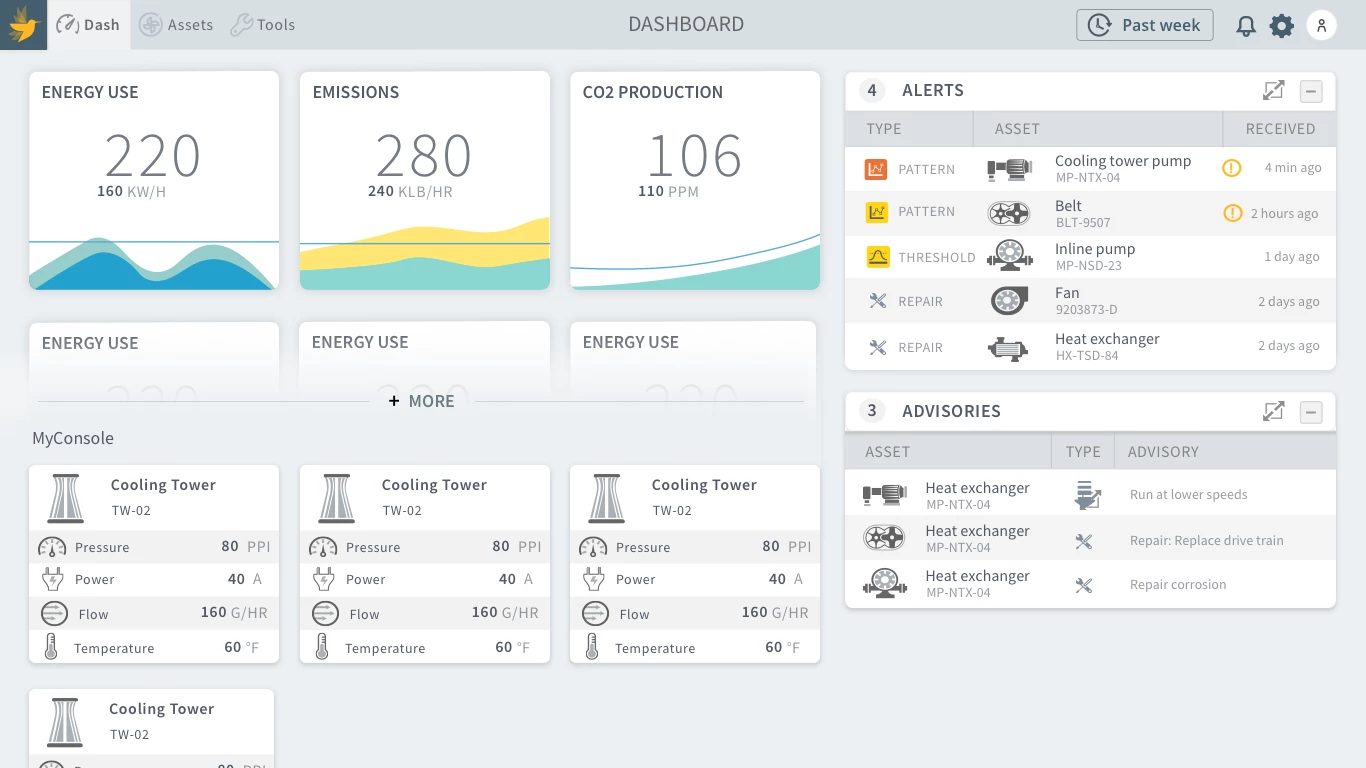
Symphony Industrial AI answers with a pre-built, template-driven approach that minimizes data scientist requirements and promotes rapid predictive analytics deployments. The solution features a data management platform for the process manufacturing sector. It provides real-time stream processing on time-series and related data for predictive analytics, leveraging cloud and big data technologies. The figure below shows an example of the solution’s dashboard.
Symphony Industrial AI’s solution speeds time-to-value through rapid deployment for minimized time and financial investment. Some of its features include:
- Operations Date Lake (ODL): Pre-built integrations to existing systems of record (historians, EAM/CMMS, SCADA, and more).
- Equipment and process template library: A library of equipment and process templates (pre-packaged analytics) that accelerate implementation and time-to-value.
- AI/ML algorithms: Pre-packaged algorithms for failure/anomaly prediction.
- Asset 360 AI and Process 360 AI: Pre-packaged solutions for asset performance intelligence and operations/process intelligence, respectively.
Two solutions: equipment models and process models
Predictive analytics solutions tend to focus on equipment health as scenarios, as the data is readily modeled. To ease the implementation, Asset 360 AI deploys equipment models (also known as asset models) from a template library — which includes heat exchangers, pumps, compressors, and so forth.
Symphony AI’s second solution Process 360 AI helps users create predictive models of their processes. A process is defined at the high level as the items (such as chemicals, fuels, metals, other intermediate and finished products) that are being produced through the equipment. Process template examples include an ammonia process, an ethylene process, an LNG process, and a polypropylene process. Process models help predict process upsets and trips — which equipment models alone may not be able to predict.
Benefits
Built with AI and machine learning (ML), Asset 360 AI and Process 360 AI integrate seamlessly with the equipment and devices already owned. The solutions predict failures before they happen, resulting in several benefits.
- A reduction in unplanned downtime and process trips.
- A reduction in capital expenditure and asset maintenance costs.
- Improvement in quality using gathered process and product data.
- Improvement in safety and in tracking workforce effectiveness.
Microsoft technologies
Symphony Industrial AI’s solution is delivered as a SaaS model on Azure using the following services:
These services ensure the latest features of IoT and AI advances can be implemented. Additionally, Power BI gives users a rich surface to use for finding insights and monitoring processes.
For manufacturers looking for a way to introduce predictive analytics, Symphony Industrial AI offers two solutions that are easy to implement through a template-driven process. The template libraries include models for existing equipment and standard manufacturing flows. To find out more, go to Asset 360 AI or Process 360 AI and select Contact me.