As we highlighted in our latest attack trends report, Distributed Denial-of-Service (DDoS) attacks are one of the biggest security concerns today. Whether in the cloud or on-premises, DDoS attacks can be targeted at any endpoint that is publicly reachable through the internet. Planning and preparing for a DDoS attack is crucial to a well-vetted incident management response plan.
Today, Microsoft is excited to announce a new collaboration with Red Button, offering our customers an additional DDoS attack simulation testing provider to choose from. With Red Button’s DDoS Testing service suite, you will be able to work with a dedicated team of experts to simulate real-world DDoS attack scenarios in a controlled environment. Simulation testing allows you to assess your current state of readiness, identify gaps in your incident response procedures, and guide you in developing a proper DDoS response strategy.
Red Button DDoS Testing
Red Button’s DDoS Testing service suite includes three stages:
1. Planning session
Red Button experts meet with your team to understand your network architecture, assemble technical details, and define clear goals and testing schedules. This includes planning the DDoS test scope and targets, attack vectors, and attack rates. The joint planning effort is detailed in a test plan document.
2. Controlled DDoS attack
Based on the defined goals, the Red Button team launches a combination of multi-vector DDoS attacks. The test typically lasts between three to six hours. Attacks are securely executed using dedicated servers and are controlled and monitored using Red Button’s management console.
3. Summary and recommendations
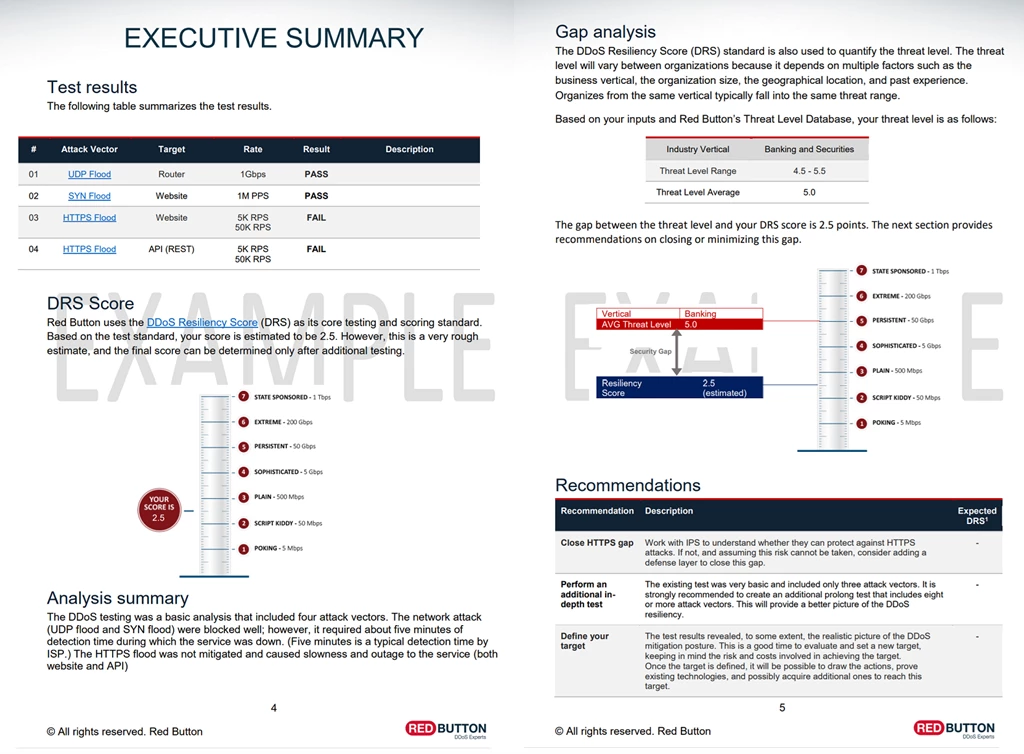
The Red Button team provides you with a written DDoS Test Report outlining the effectiveness of DDoS mitigation. The report includes an executive summary of the test results, a complete log of the simulation, a list of vulnerabilities within your infrastructure, and recommendations on how to correct them.
Here is an example of a DDoS Test Report from Red Button:
In addition, Red Button offers two other service suites that can complement the DDoS Testing service suite:
- DDoS 360 is an “all included” annual service that includes the DDoS Testing, DDoS Hardening, DDoS team skills development, and DDoS Incident Response services. The program consists of multiple year-round activities carried out by Red Button’s top DDoS experts, which includes extensive pre-attack activities to strengthen your technological infrastructure and improve the skills of your teams as well as a dedicated incident response expert team in the event of an attack.
- DDoS Incident Response (IR) is a 30-day incident response service that consists of three phases: when under a DDoS attack or DDoS threat (for example, DDoS ransom threat), Red Button DDoS experts are immediately assigned and work closely with your security and IT teams to analyze the attack and apply the appropriate mitigations. Once the attack has been fully mitigated, Red Button audits your network architecture and DDoS protection system configuration, including running a DDoS test and provides detailed recommendations for hardening and optimization to prevent future attacks. Lastly, Red Button conducts DDoS training for your teams to increase your skills and readiness, and helps you build a DDoS Playbook that provides detailed procedures and activities to prepare for any future attack.
Azure DDoS simulation testing policy
Red Button’s simulation environment is built within Azure. You can only simulate attacks against Azure-hosted public IP addresses that belong to an Azure subscription of your own, which will be validated by Azure Active Directory (Azure AD) before testing. Additionally, these target public IP addresses must be protected under Azure DDoS Protection. Red Button services are sold separately from Azure DDoS Protection and can be purchased directly through Red Button.
You may only simulate attacks using our approved testing partners:
Learn more
- Red Button: DDoS Services—Protection Consulting and Testing.
- Azure DDoS Protection simulation testing partners: Azure DDoS Protection simulation testing documentation.
- Microsoft penetration testing guidelines: Penetration testing documentation.
- Azure DDoS Protection Standard product page.
- Azure DDoS Protection Standard documentation.
- DDoS Protection best practices.