We are excited to announce availability of the new H-series virtual machines in Azure. With the availability of these new VM sizes we continue our mission to deliver great performance for HPC applications in Azure. H-series VM sizes is an excellent fit for any compute-intensive workload. They are designed to deliver cutting edge performance for complex engineering and scientific workloads like computational fluid dynamics, crash simulations, seismic exploration, and weather forecasting simulations.
The new H-series sizes are initially available in the South Central US Azure region and will be rolled out across other regions in the near future.
The H-series VMs will be available in six different sizes, all based on Intel E5-2667 V3 3.2 GHz (with turbo up to 3.5 GHz) processor technology, utilizing DDR4 memory and SSD-based local storage. The new H-series VMs furthermore features a dedicated RDMA backend network enabled by FDR InfiniBand network, capable of delivering ultra-low latency. RDMA networking is dedicated for MPI (Message Passing Interface) traffic when running tightly coupled applications.
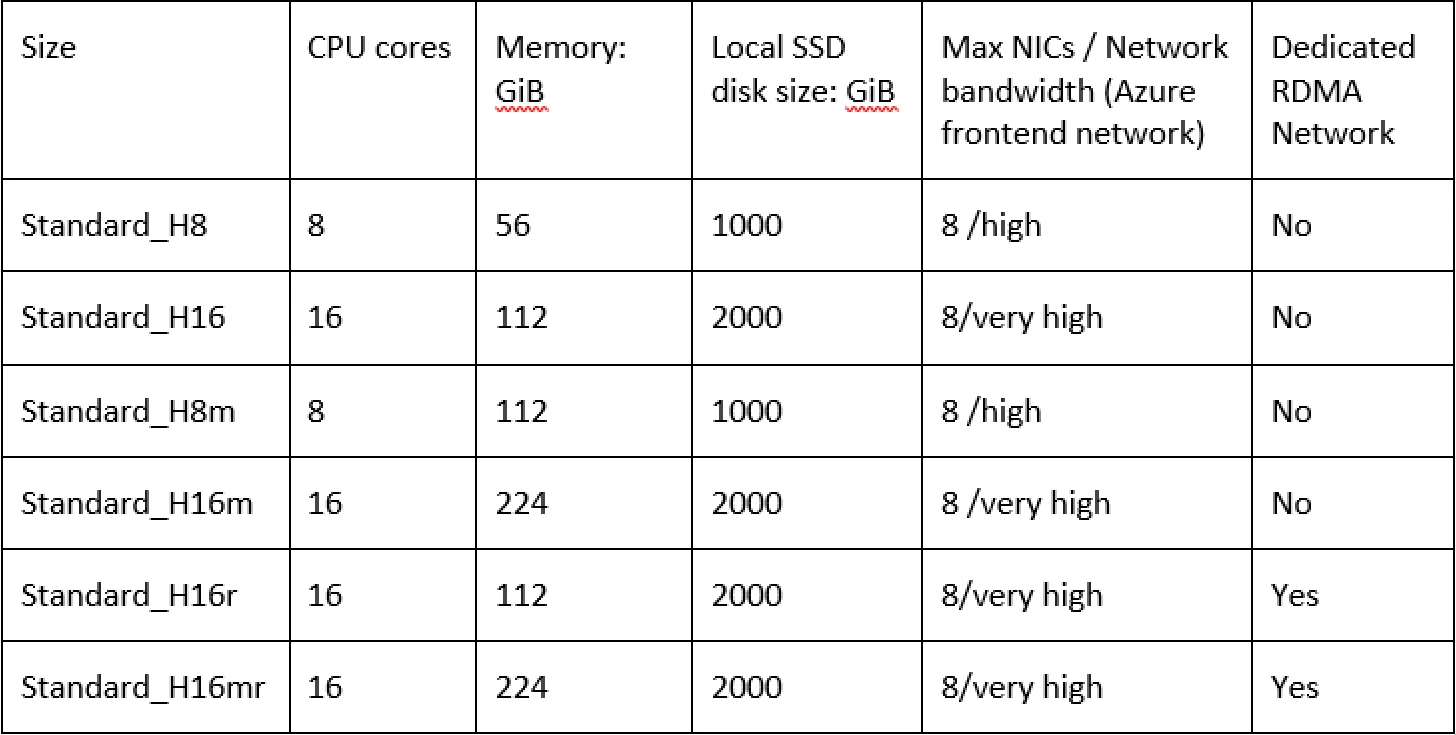
*m: High Memory, r: RDMA network
We see a large number of enterprise customers embracing Microsoft Azure for their enterprise HPC workloads. Enterprise customers bursting their HPC jobs to Azure for additional compute power helping to solve complex design of experiments (DOE), optimizations, and other critical projects. One of our premier partners, Altair Engineering Inc., with its suite of enterprise computing products is an excellent and current example of integration between customers’ on-premises environment and H-series VMs in Azure.
“We are excited about the introduction of new non hyper-threaded compute and network optimized H-series VMs in Azure, we worked closely with the Microsoft Team to test our solutions for performance and scaling on the H Series VMs. Based on the testing we are confident not only to deliver high performance to our customers but also provide deep integration with the Azure environment to enable HPC cloud environments”
Sam Mahalingam, CTO Altair Engineering Inc
H-series VMs can deliver great performance running a variety of applications, helping businesses around the world reducing their product development cycle and bring products faster to market.
“We are pleased to see the launch of the new Azure high performance H series VMs with InfiniBand and Linux RDMA technology. This performance accelerates the pace of product design cycles using simulation and helps engineers discover better designs, faster.”
– Keith Foston, Product Manager, CD-adapco, a Siemens Business
H-series virtual machines provide on demand compute capacity for our customers that want to solve complex automotive crash simulation problems. Through partners like d3View we can bring large scale computing capabilities to our customers when needed.
“We see a great need for the best-in-class compute power and capacity. With the introduction of Azure’s new H-Series with E5-2667 processor and RDMA InfiniBand network, running large-scale simulations across hundreds of cores will offer reduced turn-around time for simulation engineers and scientists. Multi-physics simulation software like LS-DYNA is designed to scale to thousands of processors and with the H-Series, we look forward to helping our customers in evaluating designs quickly”
Suri Bala, CEO d3View
The low-latency RDMA network enabled by FDR InfiniBand in the H-series VMs, particularly using the H16r and H16mr sizes, make up an ideal combination for delivering the necessary scale and performance for very large CFD (Computational Fluid Dynamics) simulations.
“The RDMA technology in the new H series VMs is critical when running large scale-out jobs on the cloud. With clock frequencies flattening out the last few years, RDMA technology enables jobs to scale out to large number of nodes. Our testing of CFD codes with the TotalCAE Portal enabled us to achieve reduced runtimes at large core counts that would not be possible without RDMA technology in Azure.”
Rod Mach, CEO TotalCAE
Non-RDMA-enabled H-series sizes can be deployed with various Linux distributions and Windows Server OS images available in the Azure Marketplace. RDMA-enabled H-series VM sizes can be deployed using Windows Server 2008 R2, Windows Server 2012, Windows Server 2012 R2, and CentOS-based 7.1 HPC and SUSE Linux Enterprise Server 12 SP1 HPC images. For more information and a quick guide on how to get started, see the Linux and Windows documentation.
With this milestone in our HPC journey in the cloud, we’d like to re-emphasize our excitement in bringing world-class High Performance Computing infrastructure capabilities through the Cloud to every engineer and scientist in the world.